The Five “Can’t-Miss” Transfusion Reactions — and What to Ask in the Moment
- Oct 27, 2025
- 2 min read
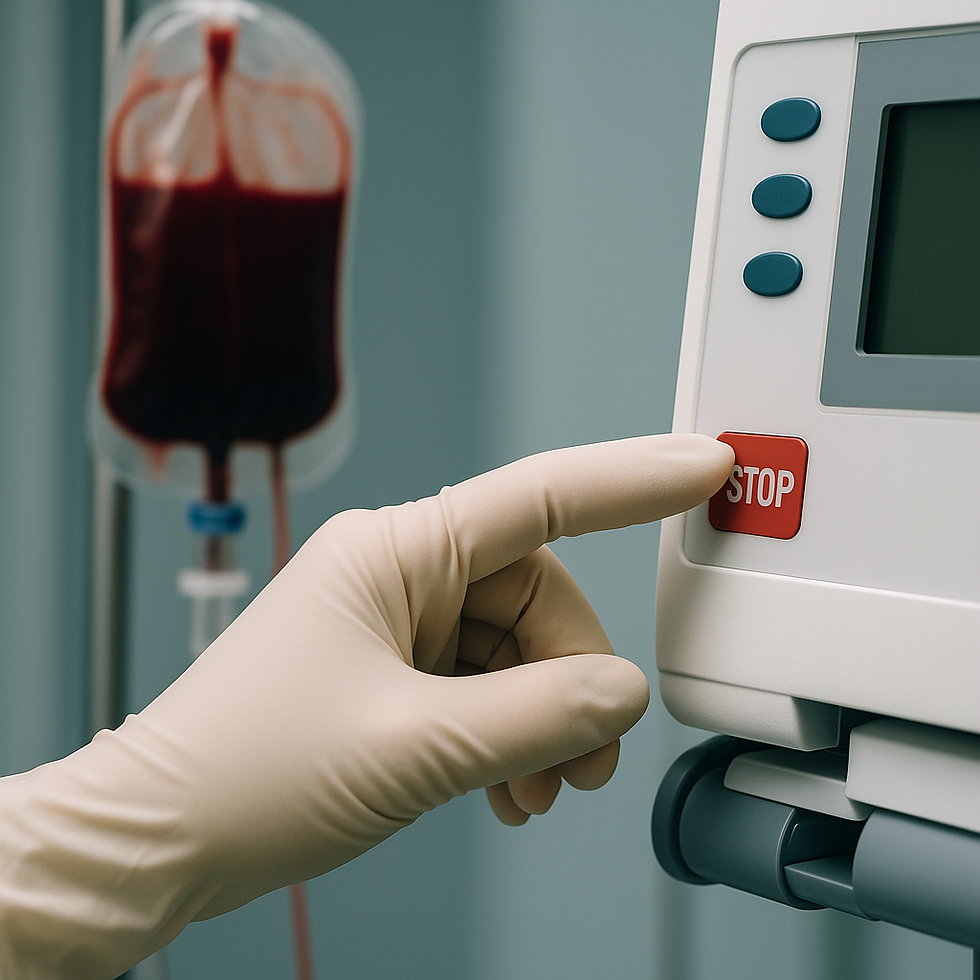
When the phone rings mid-transfusion and the words “the patient is hypotensive” hit your ears, there’s a short list of life-threatening reactions you can’t afford to miss. Four share a similar opening act — fever, hypotension, and sometimes respiratory distress. The fifth looks different but can end the same way if unrecognized.
Here’s how to triage the call, fast.
1️⃣ Anaphylaxis
Clue: Sudden hypotension, respiratory distress, flushing, or urticaria — often within minutes of starting the unit.
Ask: “Did the team give epinephrine?”
If they didn’t, that’s step one. Stop the transfusion, keep the line open with saline, and treat per anaphylaxis protocol. Later, you’ll think about IgA deficiency and washed products — but right now, it’s airway, breathing, circulation.
2️⃣ Septic Transfusion Reaction
Clue: Fever and rigors that escalate to shock, often during or shortly after transfusion.
Ask: “Did the team send blood cultures and start antibiotics?”
Stop the transfusion immediately and culture both patient and product. Gram-negative sepsis from a contaminated platelet or red cell unit can mimic anaphylaxis in its speed.
3️⃣ TRALI (Transfusion-Related Acute Lung Injury)
Clue: New or worsening hypoxia and bilateral infiltrates within 6 hours of transfusion, without signs of circulatory overload.
Ask: “Did the oxygen saturation drop or the O₂ requirement go up?”
If yes, order a chest X-ray. This is non-cardiogenic pulmonary edema — no diuretics, no fluids, just supportive care and notification to the blood bank.
4️⃣ Acute Hemolytic Transfusion Reaction (AHTR)
Clue: Fever, flank or back pain, hypotension, dark urine, or a sudden rise in bilirubin.
Ask: “Can you send a DAT and haptoglobin?”
This one’s about clerical error until proven otherwise. Check patient and unit IDs, call the blood bank, and prepare for aggressive hydration to protect the kidneys.
5️⃣ TACO (Transfusion-Associated Circulatory Overload)
Clue: Hypertension, dyspnea, pulmonary edema, elevated BNP — usually in patients with limited cardiac reserve.
Ask: “Did the team give diuretics, and did the patient respond?”
Unlike TRALI, TACO should improve with diuresis. Prevention is key: slow rates, split units, pre-dose furosemide when indicated.
🩸 Putting It All Together
Reaction | BP Trend | Fever | Resp Distress | Key Test / Treatment |
Anaphylaxis | ↓ | ± | + | Epinephrine |
Septic | ↓ | + | ± | Cultures + Antibiotics |
TRALI | ↓ | ± | + | CXR → Non-cardiogenic edema |
AHTR | ↓ | + | ± | DAT / Haptoglobin |
TACO | ↑ | – | + | Diuretics → Improves |
Bottom line:
When every minute matters, think pattern-recognition first, paperwork later.
Five questions can save a life — and keep you calm when the call comes in.


