No Show, No Ride: Fuel Prices and the New Math of Missed Appointments
- Jun 26
- 4 min read
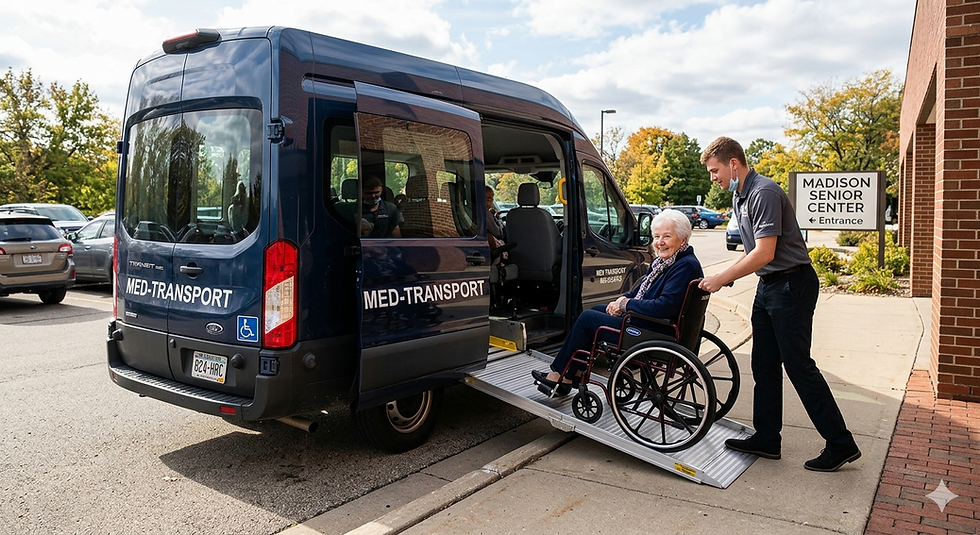
A patient calls the clinic the morning of their appointment. Their ride canceled. Again. The scheduler offers to rebook, but the patient hesitates — they've already canceled twice this month for the same reason, and they're starting to wonder if the clinic thinks they just don't want to come in. They do. They just can't get there.
I've heard versions of this story enough times recently that it stopped feeling like a string of coincidences and started feeling like a pattern. Transport companies are declining Medicaid and Medicare rides because the reimbursement doesn't cover the cost of fuel to get there. No-shows and cancellations are climbing. And in a separate but oddly parallel thread, research coordinators are reporting that study participants — people who once reliably showed up for their visits — are skipping appointments because the incentive payment no longer covers what it costs to drive there.
These are two different systems, two different funding mechanisms, two different sets of patients. But they're failing for the same underlying reason, and I don't think that's a coincidence.
How a flat rate breaks under a variable cost
Non-emergency medical transportation, or NEMT, is supposed to be the safety net that gets Medicaid and Medicare beneficiaries to dialysis, infusion, oncology follow-up, and the dozens of other appointments that can't happen by telehealth. The way these trips are usually priced is a base rate plus a per-mile mileage fee, and that mileage fee is explicitly built to reflect local fuel prices, vehicle maintenance, and regional economic conditions. Reimbursement rates themselves vary enormously by state — the same wheelchair-accessible trip might pay around $100 in one state and roughly a third of that in another, because federal law requires states to provide NEMT but leaves the actual payment rate entirely up to them.
That structure works fine as long as the underlying cost of driving stays roughly where it was when the rate was set. It does not work when fuel prices climb faster than the rate gets revised. A transport company running on Medicaid mileage reimbursement doesn't have the option of just absorbing the loss trip after trip — they stop taking the trips. Which is, anecdotally, exactly what's happening.
The data we already had
Here's the part that surprised me a little: we didn't need a fuel crisis to know transportation barriers cause missed appointments. That literature already exists, and it's not small. A frequently cited estimate puts the number at roughly 5.8 million Americans missing or delaying medical care annually because of transportation barriers, concentrated in rural and underserved urban areas where transportation options are already limited. In one study of caregivers in Houston, an inability to find a ride caused at least one missed appointment in a quarter of the sample. A systematic review and meta-analysis of interventions aimed at exactly this problem — vans, bus vouchers, rideshare — found they meaningfully reduced missed appointments, though the evidence on whether that translated into better health outcomes or lower costs was too thin to say for sure.
So the mechanism by which "can't get a ride" becomes "missed dialysis session" was already well established. What's new isn't the mechanism. It's the scale and speed at which fuel prices are stressing a system that was already running close to the edge.
The same problem, wearing a different badge
The research side of this is structurally different but rhymes uncomfortably well. Clinical trial and study compensation has its own literature on travel reimbursement, and it's clear on one point: covering travel costs isn't a perk, it's often the thing standing between "this person can participate" and "this person can't afford to." One review of payment practices noted that travel costs remain one of the most significant barriers to clinical trial participation, particularly for low-income participants. Separately, researchers studying recruitment and retention have argued that travel reimbursement is an appropriate and valuable incentive precisely because, without it, participation becomes a luxury good — available to people who can absorb the cost of getting there, and closed to everyone else.
If incentive payments were calibrated to cover a $15 round trip in gas and now the actual cost is closer to $25, that calibration has quietly become a barrier, even though the dollar amount on paper hasn't changed. The people most likely to drop out under those conditions are, predictably, the people for whom that gap matters most — which is its own quiet threat to the diversity and generalizability of the data we're collecting.
What I can't tell you yet
I want to be honest about the limits of what I'm describing. There is, as far as I can find, no published literature yet on this specific moment — on fuel prices rising fast enough to push NEMT providers out of Medicaid and Medicare contracts, or on research incentive payments failing to keep pace with gas prices in real time. What I have is a well-documented mechanism (transportation barriers cause missed appointments and lower trial retention) colliding with an acute, recent stressor (fuel costs outpacing reimbursement) that hasn't been studied yet because it's still happening.
It would be tidier to end this with a clear causal claim and a clean policy fix. I don't think I'm entitled to either yet. What I can say is that two systems I don't normally think about together — clinical transportation logistics and research recruitment economics — are both showing the same symptom right now, and that symptom is patients and participants disappearing from the schedule not because they don't want to be there, but because the math of getting there no longer works.
A structural irony, if you're looking for one
The patients most likely to need frequent transportation-dependent care — dialysis, transfusion, infusion therapy, complex follow-up — are, by definition, the ones who can least afford for this particular gap to widen. We built a system where access to care depends on a per-mile rate someone set years ago, in a different fuel market, and we're now finding out what happens when that assumption quietly stops holding.


